
Choosing the right EVA Shoe Mould in 2026 requires more than comparing prices or copying a supplier’s catalogue. A reliable decision starts with the finished shoe. Consider its outsole pattern, foam density, size range, intended use, and expected production volume. A lightweight beach sandal needs different cavity details from a supportive running sole. Small differences matter.
In practical factory work, mould accuracy affects flashing, surface texture, demoulding, and final dimensions. Check the mould’s aluminium or steel grade, cavity balance, ventilation, cooling channels, and compatibility with your compression or injection equipment. Ask for dimensional reports, trial samples, and evidence of quality control. A trusted manufacturer should explain shrinkage calculations clearly. Vague promises are warning signs.
There is no universal best choice.
A mould can look precise on a workbench yet perform poorly during repeated production. Heat distribution may change. Fine tread lines can fill unevenly. Even an experienced buyer can overlook maintenance access or replacement-part availability. That is why a controlled trial remains essential before approving a large order. Measure several samples, inspect edges under strong light, and compare left and right sole consistency. Record defects instead of relying on memory.
This guide explains how to assess an EVA Shoe Mould with practical, evidence-based criteria. It also examines supplier experience, testing methods, production efficiency, and long-term costs. The goal is not merely to buy a mould, but to select a dependable tool that supports stable quality in 2026 and beyond.
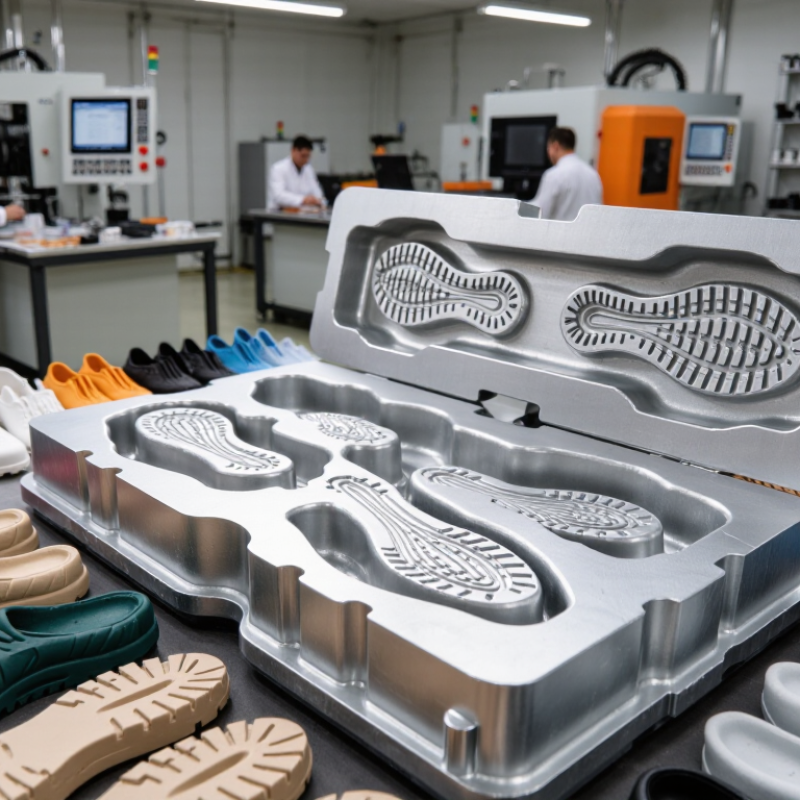
How to Choose the Best EVA Shoe Mould in 2026?
Define EVA Shoe Mould Requirements for Your Product
Choosing an EVA shoe mould starts with product requirements, not mould appearance. Define the shoe’s weight, hardness, rebound, thickness, size range, and expected daily output. These details control cavity design, material flow, cooling channels, and shrinkage allowance. A lightweight slipper needs different venting from a dense running sole. Small details matter.
The World Footwear Yearbook 2024 reported global footwear production of 23.9 billion pairs in 2023. Asia produced about 87% of that volume. This scale increases pressure on mould stability, cycle time, and repeatable dimensions. For export-oriented production, specify tolerances in millimetres, not vague terms like “good fit.” Also record the EVA formulation, expansion ratio, injection temperature, and target density before machining begins.
A practical requirement sheet should include cavity count, parting-line position, surface texture, logo depth, cooling layout, and acceptable flash. Ask for trial data, including weight variation and rebound results. ASTM or ISO-based testing can improve reliability, but laboratory results may not match factory conditions. The first mould trial is rarely perfect. That is normal, though easy to underestimate. Recheck shrinkage after several production cycles, because heat can expose weaknesses hidden during sampling. Grand View Research’s EVA market analysis identifies footwear as a major application, reinforcing the need for scalable mould specifications rather than one-off prototypes.
The chart presents practical selection priorities for EVA shoe moulds. Dimensional accuracy and weight consistency are essential for stable shoe sizing and cushioning performance, while cycle efficiency supports higher production output. Cooling uniformity and surface-detail capability help reduce deformation, uneven density, and visual defects.
Choosing the best EVA shoe mould in 2026 requires more than checking its price. Material selection affects heat transfer, durability, weight, and repair costs. Aluminum moulds cool quickly and suit shorter production runs. Steel moulds resist repeated pressure and abrasive cleaning better. However, steel may slow cooling and increase machining time. A polished cavity can improve surface appearance, but excessive polishing may hide tiny design defects.
Design details deserve close inspection. The mould should match EVA expansion behavior, including shrinkage allowances and suitable draft angles. Deep grooves, sharp corners, and thin sidewalls can create uneven filling or difficult demoulding. Vent positions matter too. Poor ventilation may leave small surface marks or incomplete textures.
Replaceable inserts can protect high-wear areas, although they add alignment work. Keep it practical. Test the heel and forefoot separately when possible.
Manufacturing method also changes the result. CNC machining offers accurate geometry for most cavities, while EDM helps produce fine details and narrow features. A prototype made through additive manufacturing can reveal fit problems before cutting production metal. Yet its surface may not represent the final mould perfectly. I once underestimated that difference during a sample review. The outsole looked acceptable, but its texture softened after machining. Measure critical areas with inspection tools, not eyesight alone. Check trial samples for weight, rebound, dimensions, flash, and release marks. No mould is flawless. A slightly simpler design may deliver more reliable shoes.
How to Choose the Best EVA Shoe Mould in 2026?
Evaluate Precision, Durability, and Production Efficiency
Choosing the best EVA shoe mould in 2026 requires more than comparing prices. Precision should guide the decision. Ask for dimensional drawings, cavity tolerances, and sample measurements before production. A reliable mould should reproduce outsole patterns, edge thickness, and ventilation details consistently. Check the first molded pair at room temperature and after compression testing. Small size errors can create uneven fitting or visible sole distortion. That matters on the factory floor.
Durability depends on material selection, surface treatment, and maintenance access. Inspect cooling channels, ejector areas, hinges, and high-wear corners. These details often fail before the main cavity. A mould that opens smoothly reduces damage to soft EVA parts. Request a trial run with the intended EVA compound, not a substitute. Record cycle time, demolding force, temperature stability, and rejected pairs. Numbers are more useful than confident promises. Still, no test predicts every production condition.
Production efficiency comes from balanced heating, quick cleaning, and simple changeover. Compare actual cycle data, energy use, and downtime records. A higher purchase cost may be reasonable if it reduces daily adjustments. However, faster is not always better. Excessive speed can cause incomplete filling, trapped air, or uneven foaming. I would approve the mould only after reviewing several trial batches and inspecting random pairs. Leave room for correction. The best choice must serve both the machine and its operators.
Technical comparison of common mould construction options for EVA footwear production.
| Evaluation Dimension | Cast Aluminum Mould | CNC-Machined Aluminum Mould | Steel Mould | Selection Implication |
|---|---|---|---|---|
| Typical Material Density | Approximately 2.6–2.8 g/cm³ | Approximately 2.6–2.8 g/cm³ | Approximately 7.7–8.0 g/cm³ | Aluminum is easier to handle and generally reduces mould-weight requirements. |
| Thermal Conductivity | Approximately 150–220 W/m·K | Approximately 150–220 W/m·K | Approximately 25–60 W/m·K | Higher conductivity can support faster, more uniform heating and cooling when the machine and cooling layout are properly designed. |
| Typical Dimensional Tolerance | About ±0.20–0.50 mm | About ±0.05–0.15 mm | About ±0.03–0.10 mm | Use CNC aluminum or steel when sole geometry, logo detail, or parting-line control is critical. |
| Surface Detail Capability | 3/5 Suitable for standard textures and moderate detail | 4/5 Suitable for fine textures and controlled geometry | 5/5 Best for highly detailed and repeatable features | Choose the material and machining route according to the smallest feature, texture depth, and required repeatability. |
| Wear Resistance | 3/5 Moderate; softer than steel | 3/5 Moderate; depends on alloy and treatment | 5/5 High resistance to abrasion and repeated clamping | Steel is usually preferable for high-volume production or abrasive compounds, provided that cycle time and weight are acceptable. |
| Typical Tooling Lead Time | Approximately 7–15 working days | Approximately 10–20 working days | Approximately 20–40 working days | Lead time varies with cavity count, cooling channels, surface treatment, machining capacity, and approval cycles. |
| Relative Tooling Cost Index | 1.0–1.5 | 1.3–2.2 | 2.0–4.0 | Planning index only: cast aluminum is used as the baseline; actual quotations depend on size, complexity, and finishing requirements. |
| Mould Handling Efficiency | 5/5 Low weight and easy changeover | 5/5 Low weight and easy changeover | 2/5 Heavy and more demanding to move | For frequent style changes or manual loading, lightweight aluminum can improve operator ergonomics and changeover speed. |
| Process Consistency | 3/5 Depends strongly on casting quality | 4/5 Consistent machined geometry | 5/5 Excellent repeatability when maintained | Inspect venting, parting surfaces, cavity alignment, and cooling balance—not only the mould material. |
| Best-Fit Production Scenario | Short runs, standard designs, cost-sensitive development | Medium-to-high volume, precise designs, frequent product updates | Long runs, demanding detail, high wear, and maximum service life | The best choice depends on annual volume, required precision, expected tool life, and acceptable cycle time. |
| Recommended Overall Use | Value-focused option | Balanced precision and efficiency option | Heavy-duty durability option | For many EVA footwear programs, CNC-machined aluminum provides a practical balance between precision, thermal performance, weight, and cost. |
| Priority | Preferred Mould Direction | Key Technical Checks Before Ordering |
|---|---|---|
| Lowest initial tooling cost | Cast aluminum | Verify casting integrity, cavity alignment, venting, surface finish, and allowable dimensional variation. |
| Best balance for regular production | CNC-machined aluminum | Confirm alloy, machining tolerance, cooling layout, texture reproduction, and inspection method. |
| Maximum wear resistance and long service life | Steel | Confirm steel grade, hardness or heat treatment, corrosion protection, cavity weight, and machine compatibility. |
| Fastest and most stable thermal response | Aluminum, with optimized cooling | Review heating and cooling balance, temperature uniformity, venting, and cycle-time validation using production trials. |
| Highest dimensional precision | CNC-machined aluminum or steel | Define critical dimensions, tolerance zones, parting-line limits, surface-detail requirements, and sample approval criteria. |
Choosing the best EVA shoe mould in 2026 starts with supplier expertise, not attractive photographs. An experienced supplier understands EVA expansion, shrinkage, cooling behavior, and cavity balance. They should explain how mould design affects weight, softness, surface texture, and dimensional stability. Ask for previous mould samples with measured tolerances. Real evidence matters more than confident promises.
Quality control must be visible at every production stage. Check the supplier’s material certificates, CNC machining process, polishing standards, and inspection records. Request a trial mould before approving mass production. Test several pairs, not just one. Measure length, thickness, density, and compression recovery after repeated use. Small differences can create fitting problems. I have seen a clean-looking sample fail during longer trials. That weakness should be discussed openly.
Customization is equally important. Confirm whether the supplier can adjust outsole patterns, logos, hardness zones, drainage details, and size ranges. Ask how revisions are recorded in CAD files. Clear revision control prevents old drawings from returning to production. Cooling channels and vent positions also deserve attention, especially for complex shapes. A supplier may accept every request, but that does not mean every request is practical. Sometimes a simpler texture improves release and reduces maintenance. Leave room for technical disagreement. Good cooperation is not blind agreement.
The cheapest EVA shoe mould rarely gives the lowest production cost. Calculate the full cost before approving a quotation. Include mould price, shipping, customs charges, sampling, machine setup, maintenance, and expected repair expenses. Add the cost of rejected pairs caused by poor venting or uneven expansion. A useful estimate is total cost per pair, not only the purchase price.
My first estimate was wrong. I compared two moulds by price and ignored cycle time. The lower-priced option required longer cooling and produced more visible flash. That small difference reduced daily output. Now I check cavity balance, steel quality, surface treatment, vent design, and replacement-part availability.
Ask for dimensional drawings, material certificates, trial records, and a clear tolerance range. Request sample testing with your actual EVA compound.
Check the numbers carefully.
A four-cavity mould may cost more, yet lower labor cost per pair. However, more cavities can increase maintenance demands. Measure energy use and cycle time during a real production trial. Inspect the heel, toe, outsole texture, and edge definition after repeated cycles. Keep a cost sheet for twelve months. It may expose assumptions you missed. Good mould selection requires evidence, not attractive promises. A practical trial is essential.